In this story:
- 1. A candle making class for the bride who wants the night in, not the night out
- 2. A soap and skincare workshop is the chilled hen activity that actually feels like a spa day
- 3. A flower arranging class works for hen groups that want pretty and low-effort
- 4. A pottery class is the closest thing to meditation that doesn't involve sitting still
- 5. A tea tasting works for the mixed-age hen group
- 6. A perfume making workshop is the wellness hen party with a wedding-day souvenir built in
- 7. A slow-craft workshop like kintsugi for the introvert-friendly hen do
- How to plan a low-key hen day that still feels like a celebration
If you've been to four hen weekends this year and the thought of a fifth round of penis straws and a 2am club queue is making you quietly panic, these hen do ideas are for you. There's a particular kind of bride — and a particular kind of hen group — who'd rather spend the day making something with their hands, eating a slow lunch, and being home by nine. That's not boring. That's a wellness hen party, and there are a lot more of you than the hen industry would have you believe.
The good news: most of the pressure to do The Big Night Out comes from the assumption that there isn't a better option. There is. This piece walks through seven workshops that actually deliver on the "calm" promise (some workshops that bill themselves as relaxing are, in practice, not — more on which below), plus a proper planning guide at the end for structuring the day, handling the one friend who keeps suggesting Magaluf, and matching the venue to your group size.
1. A candle making class for the bride who wants the night in, not the night out
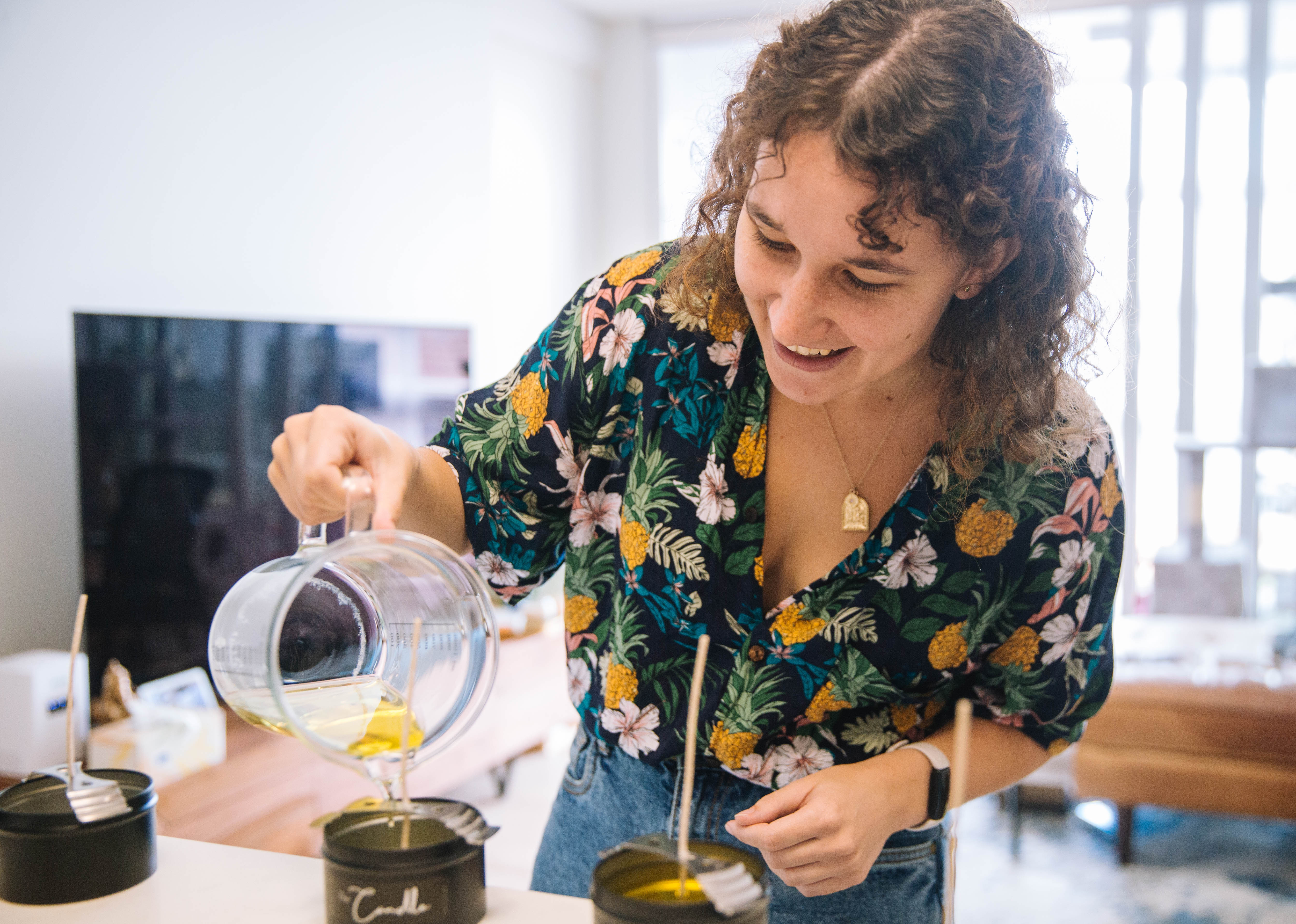
Candle making is the workshop most people land on first when they start planning a low key hen party, and there's a reason it sticks. The actual making part is quiet, focused, hands-on, and finishes inside two hours. You leave with something you'll use and nobody has to shout over a DJ.
Soy wax is the standard at most of ClassBento's candle classes — it burns cleaner than paraffin, which matters if anyone in the group has asthma or a hospitality job that leaves them inhaling enough as it is. You'll work through scent layering (a top note, a middle, a base), pour, and label your own jars. Bring something to carry them home in; warm wax doesn't love being knocked around in a tote bag.
Group size: Candle making typically caps at 16, which makes it one of the more flexible options for larger hen groups. Smaller groups of 6-8 work too and tend to feel more relaxed.
Try: Candle Making Class in Shoreditch with Dai-KOR, Candle Making in Liverpool, or Candle Making at Home (a kit-based virtual class for groups split across cities).
Crafty hen Gabriella really enjoyed her time with Dai-KOR. Here's what she had to say in her five-star review:
We arranged this for 16 people for our friends hen do. Keisha was amazing! She was patient (we were like loud excited children), professional, fun and lovely! She let us take our time and we left with the most beautiful candles. I can't wait to use mine!!
2. A soap and skincare workshop is the chilled hen activity that actually feels like a spa day
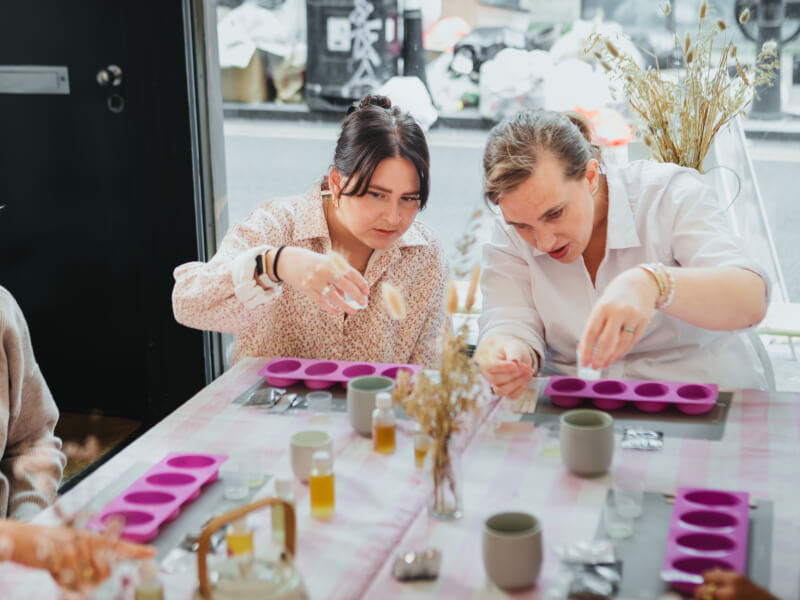
If the wedding admin has shown up on your skin — and it does — a soap and skincare class is one of the more properly restorative workshops on this list. You'll work with cold-process or melt-and-pour soap depending on the class, plus body butter, scrubs or balms, and you'll spend most of the time chatting while things set. It's slow. The teacher does the heat-management bits. You do the fun bits.
The thing nobody tells you about commercial skincare is how much of it is fillers and synthetic fragrance. Making your own — even just once — is a useful corrective. You walk out with three or four products and a much clearer sense of what's actually in the stuff you buy.
Group size: Best for 4-12. Smaller groups get more one-on-one time with the teacher; over 12 and the prep stations start to feel cramped.
Try: Soap Making in Whitechapel with ClassBento favourites Yougi, Whipped Soap Making in Brighton, or Crystal Grape Soap Making at Home (kit-based).
3. A flower arranging class works for hen groups that want pretty and low-effort
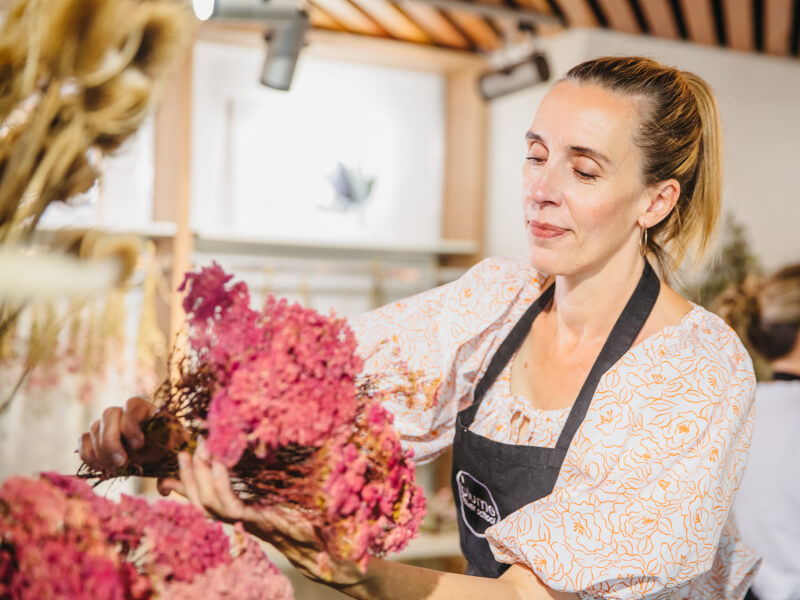
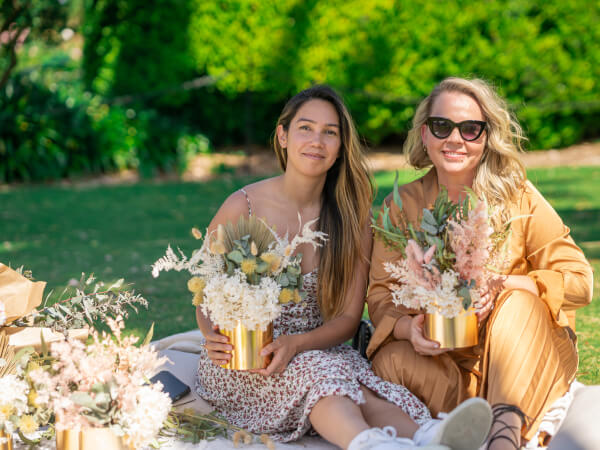
Flower arranging is the workshop everyone says yes to. It photographs well, the materials are gorgeous before you've done anything to them, and you can drink prosecco while you work without it affecting the outcome. You'll cover basic principles — focal flowers, fillers, foliage, the rule-of-three for asymmetric arrangements — and leave with a bouquet or vase arrangement that lasts the week.
If you want to lean into the pre-wedding theme, ask the teacher in advance about the bride's wedding palette and they'll often source close-enough stems. It's a small touch that lands.
Group size: 6-14 works best. Past 14 you run into bucket-and-bench logistics.
Try: Flower Arranging in Hoxton with Flower Factory LDN, Bouquet Making with the trendy FROG Flower School in Manchester, or Flower Crown Kit (posted to each attendee — useful for hen groups spread across the country).
If the bride is properly into flowers, the this article has a fuller breakdown including botanical drawing and dried-flower wreath options.
4. A pottery class is the closest thing to meditation that doesn't involve sitting still
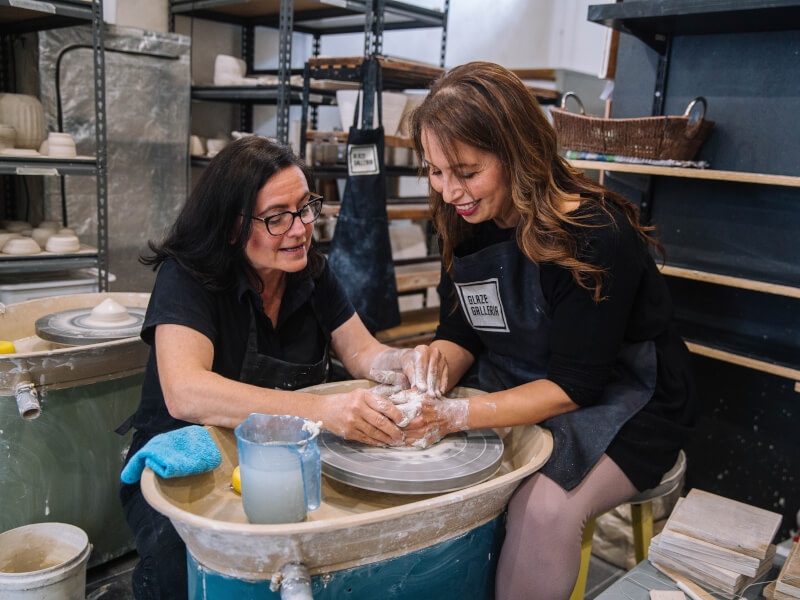
This one's earned its reputation. There's something about wet clay on a wheel that switches your brain off in a way very little else does — partly because if you stop concentrating for two seconds, the pot collapses. Forced focus is underrated.
Hand-building (pinch pots, slab work, coil work) is more forgiving than the wheel and easier to chat through, so it's the better pick if you want the social side. Wheel-throwing is more intense, more dramatic, more satisfying when it works, and produces the photos people will actually use. Most studios offer both formats.
Group size: Wheel sessions usually max out at 6-8 because of equipment. Hand-building can run up to 15-16. If your group's over 10 and you have your heart set on the wheel, look for studios with two rooms running parallel sessions.
Try: Pottery Wheel Throwing in London (can accommodate up to 40 people), Sculpt and Sip Class in Manchester with Paintvine, or Hand-building Pottery in Edinburgh.
Jasmine decided to treat her fellow hens to Paintvine's ever-popular experience - here's how they got on:
Poppy was amazing at working with us and helped me make a beautiful elephant and a pot! We did the class for a hen party and it was such a fun activity with a great vibe for the group. The class is the perfect amount of guided. You can go at it in your own and enjoy with your group or request additional help like I did. I’d highly recommend this session with Poppy as she was great and super supportive. We took our sculptures home straight after which was ideal because we don’t live in Manchester.


5. A tea tasting works for the mixed-age hen group
If the hen list runs from the bride's 22-year-old cousin to her future mother-in-law, a tea tasting solves a problem that most other hen activities don't. It's interesting for everyone, alcohol-optional, sit-down, and runs to a polite finish time. You'll work through five or six teas — usually a mix of black, green, oolong, white and herbal — with notes on origin, brewing temperatures and what to look for in each.
The best classes pair the tasting with a small bite (tea-soaked cake, shortbread, mochi) and a short bit on the history of how tea got from the Wuyi Mountains to Britain's national drink. Yes, it's our national favourite — and the right teacher can make that surprisingly interesting.
Group size: Tea ceremonies work for almost any size. Up to 20+ in larger venues; intimate 4-6 in someone's home with a kit.
Try: Tea Tasting Experience in Homerton, Matcha Workshop in Brighton, or Tea Tasting at Home (virtual, kit posted in advance).
6. A perfume making workshop is the wellness hen party with a wedding-day souvenir built in
This is one of the few hen workshops that doubles as actual wedding prep. The bride builds a perfume she likes during the class, and if she likes it enough to wear it on the day, that scent becomes the smell-memory of the wedding for the rest of her life. That's a nice piece of accidental ceremony.
You'll work through top, heart and base notes; the teacher will lay out 20-30 oils to smell; and you'll iterate towards something that suits the wearer. A good class includes a bit on the science (why some scents fade fast, what fixatives do) without turning into a chemistry lecture.
Group size: 4-12 works best. The smelling bit is hard to facilitate well with very large groups.
Try: Therapeutic Perfume Making Workshop in Edinburgh with Gill, Perfume Making in Farringdon, or Perfume Making at Home (kit-based).
Fragrance lover Nicole Spittle had a great time with her girls at Gill's class in Edinburgh - here's her glowing review
Thoroughly enjoyed our time with Gill last weekend! We booked for a hen party and it surpassed expectations, the whole group absolutely loved it and were talking about it all weekend! Gill is so knowledgeable and was so friendly, we learnt a lot and had so much fun, wouldn’t hesitate to recommend and would 100% do it again!
7. A slow-craft workshop like kintsugi for the introvert-friendly hen do
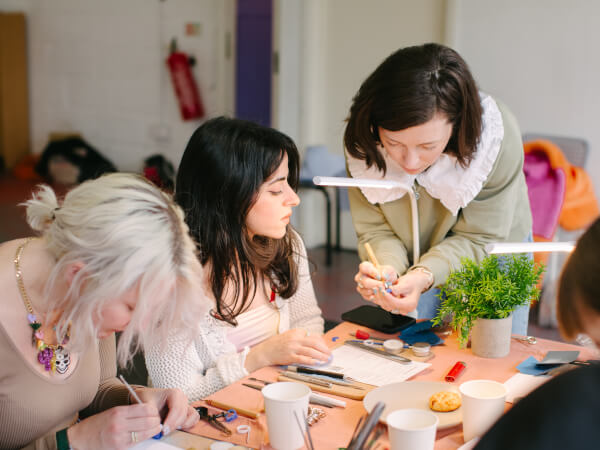
This is the category most "relaxing hen do" roundups miss, and it's the one that delivers most reliably on the calm promise. Slow crafts — kintsugi (the Japanese art of repairing broken ceramics with gold), cyanotype (the blue-tinted photographic printing process), botanical embroidery, eco-printing on fabric — all share a few traits: they take time, they reward patience over speed, and they don't require you to perform.
Kintsugi in particular has had a small renaissance in the UK wellness scene, and for the symbolic-minded bride it's a hard image to beat: a group of women repairing something broken and making it more valuable in the process. If that's too on-the-nose, cyanotype gives you the meditative wait-and-watch quality without the metaphor.
Group size: Most slow crafts run 6-12 because the technique work needs proper attention. Kintsugi specifically is often capped at 8.
Try: Kintsugi Workshop in London with Brandon Le, one of ClassBento's most popular experiences of all time, Cyanotype Printing in Bristol, or Botanical Embroidery in Edinburgh.
How to plan a low-key hen day that still feels like a celebration
This is the bit most hen-do roundups skip. Picking a workshop is the easy part — structuring the day around it is where introvert-leaning hens fall over, because the default cultural script ("daytime activity, big dinner, big night out") still applies social pressure even when the bride doesn't want it. Here's a calmer template, and how to handle the friction points.
Structuring the day: morning workshop, leisurely lunch, optional evening
The structure that works for most chilled hen activities is roughly: workshop late morning (10:30 or 11am start, two hours), straight into lunch somewhere within walking distance, then break. After lunch, hard-split the group: those who want to keep going go for cocktails or back to the Airbnb for a film and takeaway; those who want to head home, head home, and nobody makes them feel guilty about it.
The split-evening is the trick. It removes the pressure to do the second-half nightlife portion while leaving it available for the people who want it. The bride should make clear in the original group message that the evening is optional — that one sentence does more work than anything else you can do.
Managing the friend who keeps pushing for a club night
Most hen groups have one. She's not a villain — she just defaults to the standard script and assumes everyone else does too. The fix is to not let the conversation happen on the group chat where social pressure compounds. Have a one-on-one with her before invitations go out: tell her the bride wants a quiet one, name a thing you'd actually want her input on (the lunch venue, the gift, the playlist for the Airbnb), and give her a role. People who push for the big night out are often people who feel underused; give them something to do.
If the bride is the one telling you "I really don't want a club night, but [name] keeps suggesting one" — that's your cue to handle it before the invitation goes out, not after. Be the maid of honour; that's what the title's for.
Venue size: under 8 vs 10-15
Group size shifts what works:
- Under 8: Almost anything works. Private classes in a teacher's studio, an Airbnb with a kit, a restaurant's private back room. The smaller the group, the more intimate the format can be. Tea tastings and kintsugi shine here.
- 10-15: You need a workshop space built for groups, and you want to avoid anything wheel-based or one-on-one-intensive. Candle making, flower arranging, hand-building pottery, and tea tasting all scale well. Book lunch venues two weeks in advance minimum — most restaurants get awkward about group bookings of 10+ in their main room.
- 15+: Honestly, split the day. Have everyone meet for lunch, run the workshop with the closest 10-12, and use the rest of the day as an open afternoon. Trying to keep 15 people in a single workshop is where the day stops being a chilled hen activity and starts being logistics.
Planning a low key hen party isn't about doing less — it's about doing the right less. A morning making something with your hands, a slow lunch, a hug at the door, and a night where everyone sleeps in their own bed: that's a wedding send-off that the bride will actually remember fondly the week before the wedding, when she's tired and quietly grateful nobody put her in a sash.